

Facts about shoebill storks
Facts about shoebill storks: the IUCN (International Union for Conservation of Nature) estimates that the population of Shoebill storks in the wild is between 5,000 and 8,000. The majority of this bird species lives in marshes in South Sudan, Uganda, the eastern Democratic Republic of Congo, and Zambia. The IUCN has classed the shoebill stork as an endangered bird species, while Birdlife International has listed it as Vulnerable. The greatest dangers to the Shoebill stork’s survival include habitat loss caused by human encroachment on wetlands, disturbance, and poaching.
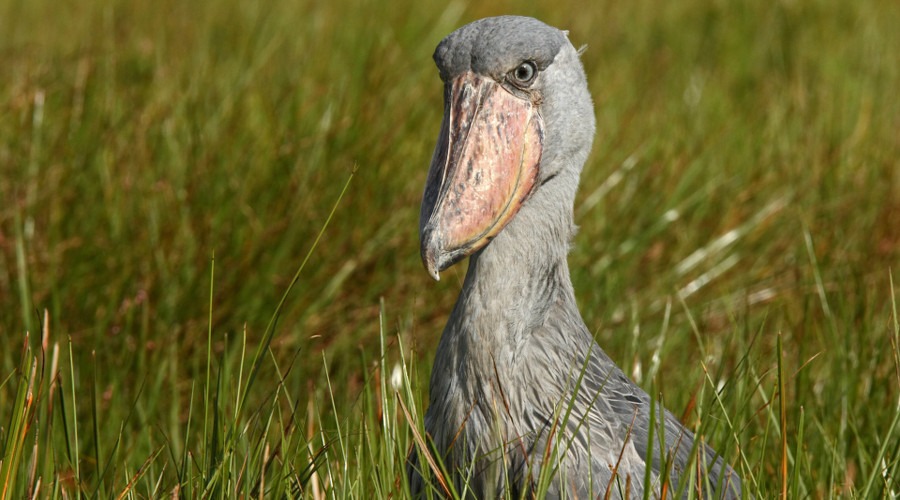
Physical description.
The Shoebill stork’s name comes from its large shoe-shaped beak. This species is also known as the Whale-headed Stork, or Shoe-billed Stork. An adult male Shoebill stork is grey, whereas juveniles are browner. Shoebill storks have lengthy feet that measure around 18cm and can reach a height of 4 to 5 feet when standing. A mature female shoebill stork weighs about 6kg, whereas a male shoebill weighs about 5kg. Shoebill storks have sharp edges in their mandibles that allow them to rip their prey while also discarding any plants they collect.
Gestation Period of the Shoebill Stork.
A shoebill stork’s gestation span is 30 days. A female shoebill stork can lay one to three eggs, which are 80 to 90 mm high, 56 to 61 mm wide, and weigh about 164 grams. The female lays her eggs in a nest that is approximately 1 to 1.7 meters wide and up to 3 meters deep. Both parents help build the nest on a floating platform. Once the chicks hatch, their parents care for them until they are around 105 days old, since at this point, they can fly. Young shoebill storks reach sexual maturity at the age of three years.
Life Cycle of the Shoebill Stork.
Shoebill storks have a longer life span than other birds. Shoebill storks can live for 35 to 50 years.
Habitat of the Shoebill Stork.
The Shoebill stork is indigenous to Africa. Shoebills are aquatic birds that live primarily in freshwater swamps in central and eastern African countries, that is southern Sudan, South Sudan, eastern Democratic Republic of Congo, Rwanda, Uganda, western Tanzania, and northern Zambia. However, there have been few reports of the species in Kenya, Ethiopia, Malawi, the Central African Republic, and Botswana. The shoebill stork is a non-migratory bird with extremely limited seasonal migrations.
Shoebill feeding
A Shoebill Stork’s food is primarily aquatic mammals such as lungfish, mudfish, catfish, eels, young crocodiles, water snakes, tilapia, snails, Nile monitors, turtles, tiny waterfowl, and even frogs. The shoebill stork catches its prey using a unique hunting strategy known as ‘freeze and seize.
The freeze and seize hunting strategy
Shoebill storks are well-known for their “freeze and seize” hunting tactic, in which they remain motionless for extended periods of time, blending into floating vegetation like a chameleon in a lush forest. When prey, like as lungfish and tilapia, approaches, they attack with the startling speed of a mouse trap slamming shut, capturing it with their enormous, muscular bills. This hunting approach is especially effective in low-oxygenated pools, where fish surface for air, much like swimmers do in a murky pond.
Movement facts regarding the Shoebill Stork
Shoebill storks can walk on two legs and even fly thanks to their large wings, which may expand up to 2.5 m when they move from one location to another. During their flight, they tend to move their heads backwards in order to stay long in the air, as well as use their huge wings to maintain balance.
The Shoebill Stork's Behavior.
Shoebill storks are notorious for being silent birds, which helps them capture their prey since they conceal silently and jump once to grasp it with their large shoe-like beak.
Shoe bills communicate with sounds and motions which include mooing, head bobbing, bill-clapping, and high-pitched whining.
This bird is notable for its slow movements and inclination to stand still for lengthy periods of time, which is why it is described as statue-like.
Shoebill storks generally defecate on themselves, and scientists have proven that they use their droppings to cool their bodies from heat.
Shoebill storks are noted for their solitary nature and prefer to live alone. Even hunting is done independently, as the male and female are only spotted together during mating season, after which each bird moves on its own.
The shoebill stork typically stands and rests on floating plants to make itself appear larger.
Social behavior
Shoebill storks are primarily solitary birds that prefer to hunt and live alone. Mating pairs only meet during the breeding season, after which they resume their solitary habits. While generally quiet as a library on a Sunday morning.
Where are shoe bill found in Uganda
The Shoebill stork is most commonly seen in Uganda, where there have been approximately 1000 sightings. They can be seen in areas such as Mabamba Swamp near Lake Victoria, Lake Mburo National Park, Queen Elizabeth National Park within the swamp in Ishasha sector, Semliki Wildlife Reserve, and Ziwa Rhino Sanctuary, and Bigodi Swamp near Kibale National Park. Uganda is a birder’s heaven, known for its abundance of Shoebill Storks.
Key Threats
One of the most serious threats to the shoebill stork is habitat loss caused by human expansion, agriculture, and drainage. These birds rely on large wetlands to nest and feed.
illicit Trade: The shoebill stork is a target of the illicit wildlife trade, and its eggs and chicks are especially vulnerable to poaching.
Disturbance: Human activities such as cattle grazing and fires in breeding areas affect the shoebill stork’s nesting success, frequently resulting in nest abandonment.
Packing list for a shoe bill watching trip
Long-sleeved, lightweight shirts and pants in neutral colors.
A warm jacket or fleece: in case it gets cold at night.
Shades and a hat with a wide brim: to block the sun.
To get good pictures of the shoebill.
For watching birds, you need binoculars.
Put on sunscreen to keep your face safe.
A portable water bottle: to drink enough water.
Use hand sanitizer.
Small bag or daypack for carrying the things you need.
Bring a power bank to keep your camera charged.